a Tardix service

I'm Albert.
I build websites for people who would rather not think about websites.
- Building for the web since 1995
- One page, built and looked after
- The website you were meant to have done last month
Tell me what your business does and I’ll build you a website that does its job, and that you never have to think about again.
Nothing to learn, nothing to set up, nothing to keep updated. That part is mine.
Pick a line to start with Tap one and it opens WhatsApp with the message already written.
Rather ring, or write? +44 (0) 1786 497366 · info@tardix.net
No forms. No account manager. The person who quotes it is the person who builds it, and the person who answers the phone afterwards.
Before you read on
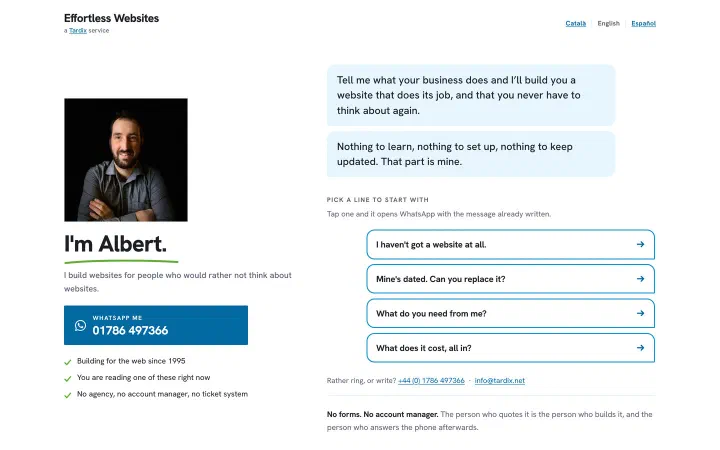
You are on one of these right now
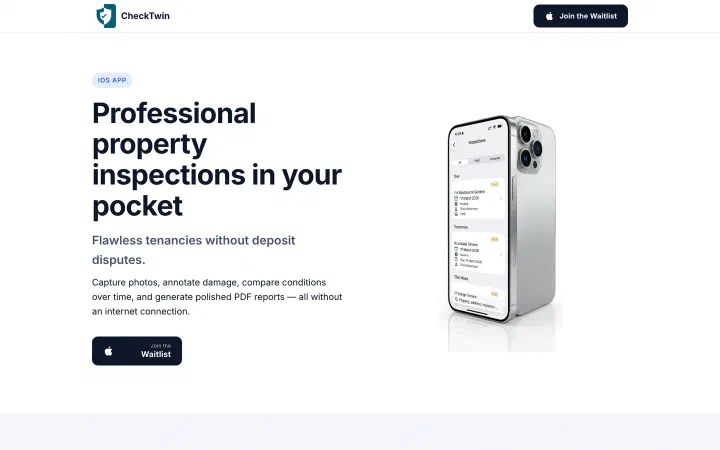
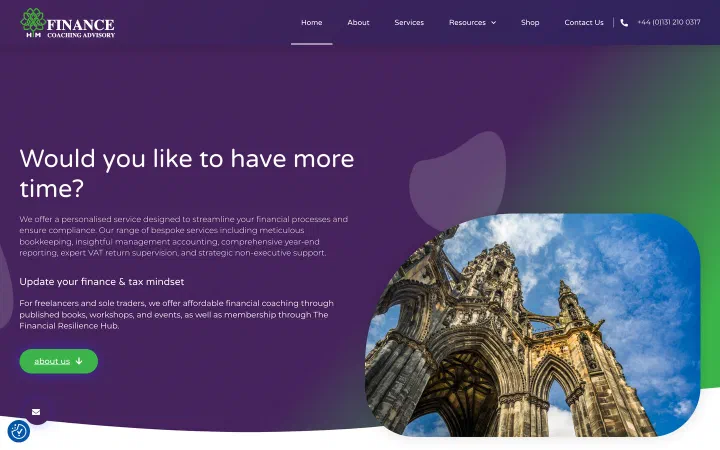
This page is an Effortless Website. Not a demo of one, not a template it was made from. If you want to know what a build gets you, you have been looking at it since you arrived. Below, this page and four more, built the same way.
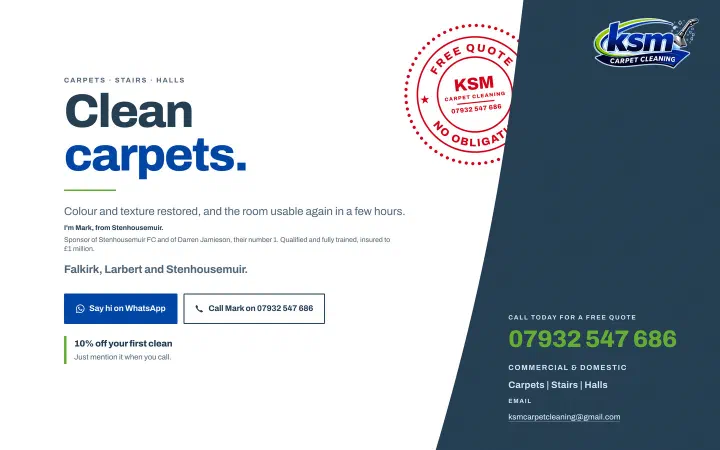
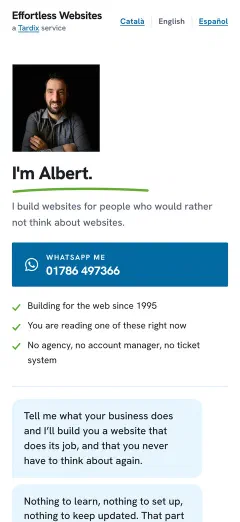
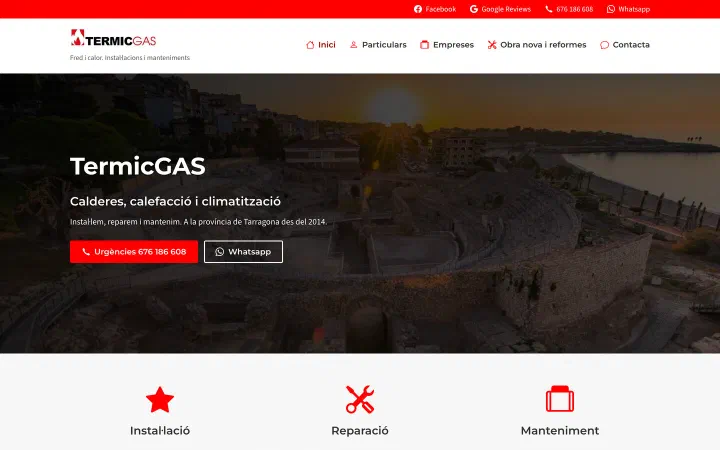
One of our 2026 websites
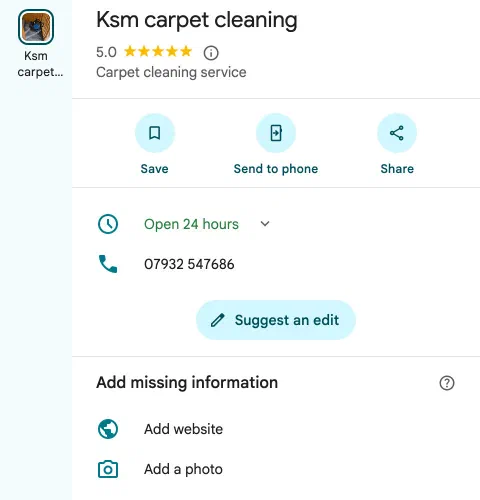
KSM Carpet Cleaning's Google listing had no website
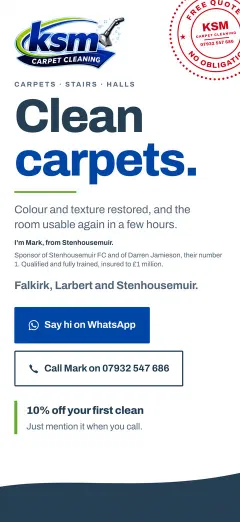
Real, not written for the page: Google’s own listing for KSM, then the site itself on a laptop and on a phone. Click through and check.


- Fast on a phone, on mobile data, on a bad signal. Nothing heavy on the page, and nothing on it waiting for somebody else’s server
- Nothing for the owner to do. No dashboard, no updates, no renewals to remember. A change is an edit to a text file, not a project
- One bill, from one person. Hosting, the domain, changes and support all come from the same place, instead of separate invoices for plugins, hosting, a developer, SEO and domain renewals
For anyone who wants to check
- No cookie banner. Nothing here tracks you and no personal data is collected, so there is nothing about your visit for a banner to ask permission for
- No third-party requests. Nothing about your visit reaches anyone else
- One stylesheet, one font file, and no JavaScript needed for any of it to work. It reads the same to a screen reader, a search engine or an AI assistant as it does to you
- Less to attack. Static files built from plain text: no login page, no database and no plugins to fall out of date, which is where small business sites usually get broken into. A server can always be attacked; there is far less here for an attack to find
Open the developer tools and look, or run it through PageSpeed Insights. The claim is either true on this page or it is worthless.
The website you keep meaning to sort
Everybody knows the business needs one. Most people also know what it costs them not to have it sorted, because they have been paying it for a while.
- “I’ll sort the website” turns into two years of not sorting the website, and a dated page that loses you the customer who looked you up and moved on
- A dashboard, a theme, a page builder and a list of plugins you were supposed to learn, and a Sunday spent updating them
- An invoice for hosting from a company you don’t remember signing up to, and no idea what happens if you stop paying it
- Notices from Google and the security certificate that nobody reads, so the one that matters looks exactly like the nine that don’t
None of that is your job. It landed on you because nobody sold you the half of a website that keeps it running.
What £399 buys, and what £50 a month keeps
The way out is one page, designed and written around the one thing you most want to sell, then built and put live, with the running of it taken off you. £399 builds it. Then £50 a month, and it is looked after.
For the build. Then £50 a month, and it is looked after.
In the £399
- A single page, designed around what you actually sell
- A domain name, registered and pointed at it
- Hosting set up, and the site live on it
- HTTPS, so no browser warns people off your site
- I write the words. You correct them
- Professional images, chosen and optimised
- Google Search Console, Business Profile and Analytics set up for you
- Submitted to Google and Bing the day it goes live
- Built to open fast on a phone, on mobile data, on a bad signal
Not in the £399
- A shop, a booking system or taking payments
- A login, customer accounts or a database
- A blog you update yourself
- Ten pages. This is one page, done properly
- A photographer. Stock images, unless you send me your own
If you need something from the second list, say so. I will quote it properly rather than stretching this one until it stops being £399. Tardix is not VAT registered, so no VAT is added to these prices.
What you get, and what stops being your problem
This is the half of a website nobody sells you and everybody ends up doing. It is the work that does not land on you, which is the entire meaning of the word effortless in the name.
Nothing to learn
There isn’t any technology to learn. You will never see a dashboard, a theme, a page builder or a plugin list. When something needs changing you send me a message instead of logging in somewhere.
Hosting handled
Set up, paid for and monitored. No control panel, and nothing arriving from a company you don’t remember signing up to. The domain and its yearly renewal are inside the monthly plan too.
Nothing to update, and less to attack
There is no WordPress to update, because there is no WordPress. No login page, no database, no plugins, which is how small business sites actually get broken into. Nothing sits on a server waiting to be patched on a Sunday.
Fast by construction
Speed is handled at the point it is decided, which is how the site is built. Not bolted on afterwards with a caching plugin. Built to open on a phone, on mobile data, on a bad signal.
Findable by search engines and AI assistants
Google and Bing are told the site exists the day it goes live, with the sitemap submitted. Real text in real headings, and the facts about your business marked up where they get looked for, so a search engine or an AI assistant sees the same page your customer does. Nobody can promise a position, and this page doesn’t.
Words written for you
The blank page is mine, not yours. You talk about your business: what you do, who calls you, what they ask for. The words on the page are written from that. You approve them; you don’t have to write them.
Built with accessibility in mind
Proper headings, text that survives being made bigger, colour contrast measured rather than guessed, and it works with a screen reader.
Enquiries straight to your phone
No contact form. Every enquiry comes by call or WhatsApp, so nothing sits in a spam folder and nobody decides you ignored them. No customer data is taken on the site at all: no form, no accounts, no list of names and emails waiting to become somebody’s problem.
None of this is extra. It is how the site is built, so it is true on the first day, and it is not something the monthly plan has to keep true.
How it goes
Four steps. You do the first one, and after that you are reacting to things I put in front of you rather than making anything yourself.
You tell me about it
A call or a message. What I need to start is short:
- The contact details you want on the site
- Your business name, or your own
- What you do, and where you do it
- Any photographs, words or logo you want used
I show you designs
How the page could look and how it could read. Reacting to something in front of you is far easier than describing it from nothing, which is most of why this step exists at all.
I build it, and we refine it
The real thing, not a mock-up. Then we work through the details together. The wording, the images, what goes first and what can wait.
Live, and working
Published, submitted to Google and Bing, and running. The monthly plan is what keeps it there. Nothing else is needed from you.
I fill in around what you send with writing and images, so a short answer to step one is enough. Nobody has ever been held up by not having a brochure.
What it costs to keep
One plan, and it is the whole of it
£50 a month, and the site is looked after. That is the plan, and it is what it is called. Hosting and the domain are the small part of it; the rest is a person on call, your changes made, and your Google entries kept current. It starts the day the site goes live.
One plan. The site stays online, and it stays looked after.
Looked after
£50
per month
The site stays up at your own address, somebody is watching it, and the changes you ask for get made.
What the plan includes
- The site online, at your own address, with its security certificate
- The domain kept pointed at it, and its yearly renewal
- Your Google presence looked after. Your Business Profile kept current, and the search side kept an eye on rather than left alone
- Somebody to ring when something looks wrong, who already knows how the site is put together
- Changes to your words, your prices and your photographs, within reason, made for you rather than quoted one at a time
- Checks that the thing is up, fast, and not linking anywhere broken
Hosting and the domain renewal are inside it, so £50 a month is the whole monthly cost and nothing arrives from anybody else. The Google accounts are set up in the build and stay yours; what the plan covers is somebody keeping them current. Within reason means the words, the prices and the pictures on the page you have; a new page or a new section is quoted separately.
How it ends, and what is kept
No minimum term. Tell me to stop and it stops at the end of that month, and the site comes down with it, because the hosting is inside the plan. There is no separate backup to buy: the site is a set of files kept in version control, so it can be rebuilt from source rather than restored from a copy of itself.
£399 for a website. What is the catch?
When do I pay?
What if I do not like it?
Can I edit it myself?
Why is there a monthly plan, and what is it for?
How long does it take?
Will people find it on Google?
Not on day one. Google usually takes between one and four weeks to review and list a new site, whoever builds it. Until then the address itself works from the first minute, on your cards, your van and your messages.
Once it is listed, the position is not fixed. Google checks the site again every few days and sends reports to whoever looks after it, and some of them say exactly what it wants changed to follow its good practices. Acting on those reports is my job: every improvement is submitted back to the search engines the moment it is published, and each one is a fresh chance to rank better. Nobody honest will promise you a position, but a site kept to Google’s good practices, with other sites and services pointing at it, keeps showing Google it is still relevant, and that is what keeps it appearing.
And there is a part only you can do, and I will talk you through it: put the address on your Google Business Profile and your social media profiles. Every real link to your site tells Google it matters.
How will I know it is actually working?
Who actually does the work?
Whenever you’re ready. Tell me what you do and I’ll tell you what I’d build.
£399 once, £50 a month to keep it online and looked after, and asking costs nothing.